Vertical Blinds vs Roller Blinds: Which Is Right for Your Melbourne Home?
Reading time:
You’re standing in the blinds aisle of your own brain, mentally flicking between two options, and getting absolutely nowhere. Vertical Blinds vs Roller Blinds: Which Is Right for Your Melbourne Home? They both promise privacy, light control, and a tidier-looking window. So why does it feel like such a big decision?
Here’s a small confession: it kind of is a big decision. Not life-altering, sure, but blinds are one of those things you’ll look at every single day for years. Get it right, and you barely notice them – they just quietly do their job and look great doing it. Get it wrong, and you’ll be mentally re-litigating the choice every time the afternoon sun hits at a weird angle.
The good news? This isn’t actually a coin toss. Vertical and roller blinds are genuinely different products, built to solve different problems. Once you understand what each one does best, the right answer for your specific window or door becomes pretty obvious.
So let’s settle this one, room by room, feature by feature.
The Basics: What Are You Actually Comparing?
Before we get into the nitty-gritty, let’s make sure we’re talking about the same things.
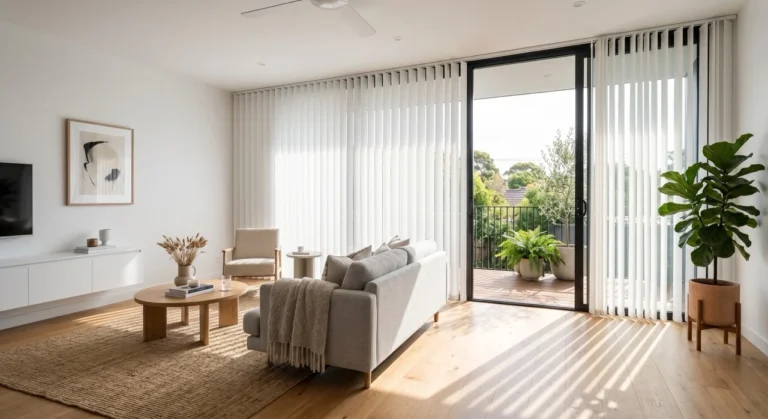
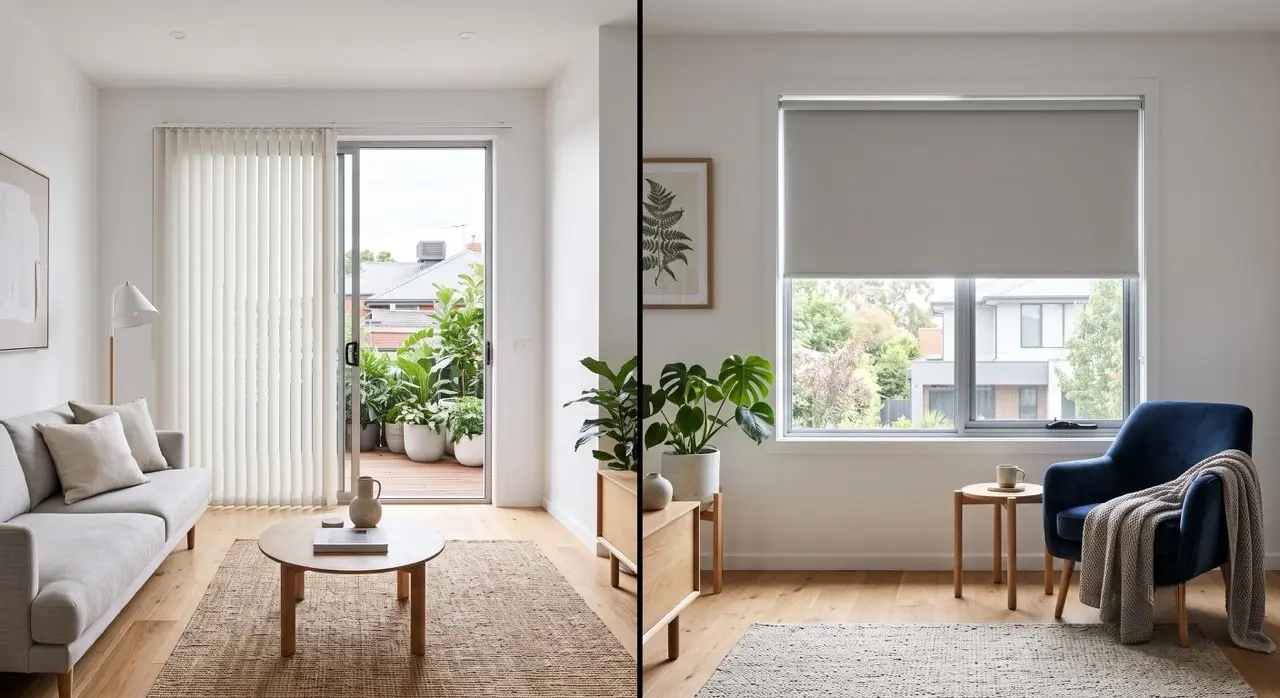
Vertical blinds are made up of individual fabric or vinyl slats – called louvres. They hang vertically from a track and rotate to control light. They feature individual vertical slats that rotate and slide sideways along a track, commonly used for wide windows or sliding doors.
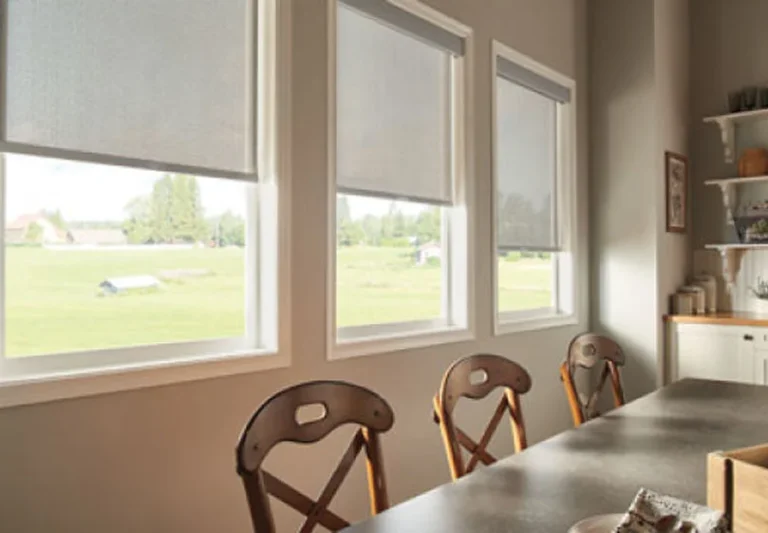
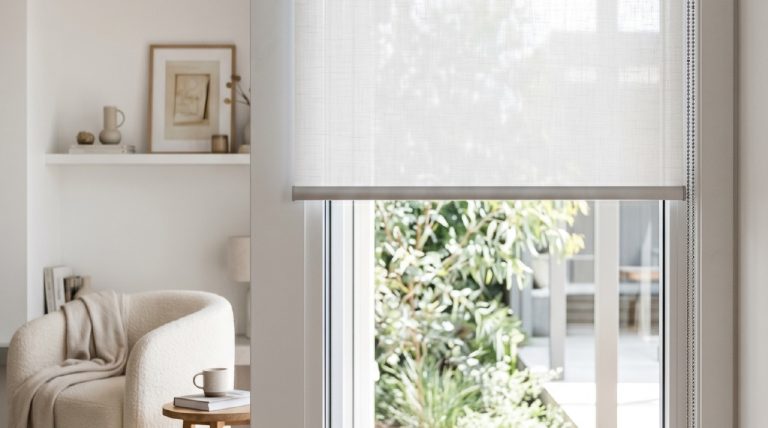
Roller blinds are a single continuous sheet of fabric that winds up and down around a tube at the top of the window. Made from a single fabric sheet that rolls up and down around an aluminium tube, they’re ideal for a modern, streamlined look.
Simple enough on paper. The differences show up once you start asking what you actually need from your window treatment.
Light Control: A Genuine Point of Difference
This is where vertical blinds earn their reputation as the more flexible option.
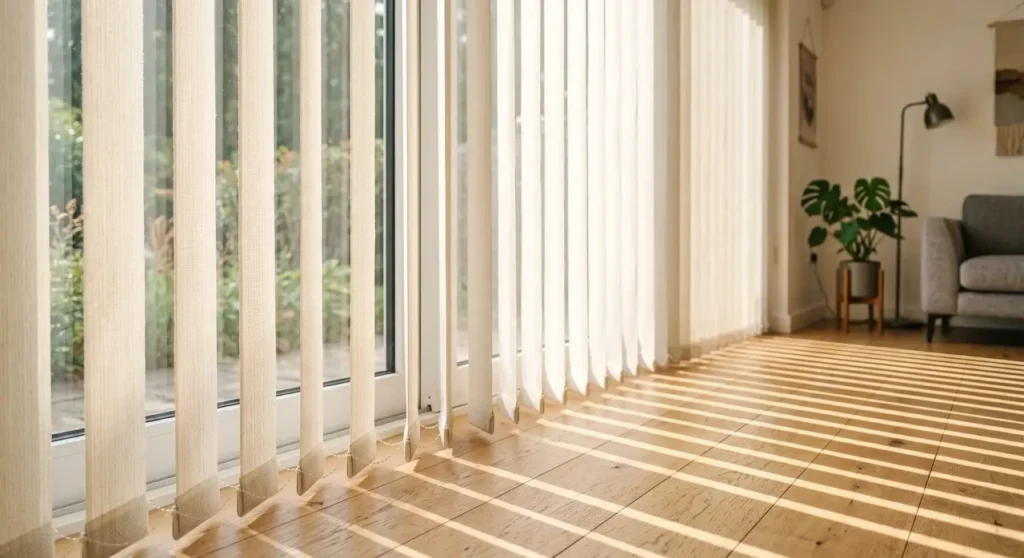
Vertical blinds excel in light control. The ability to tilt the individual slats allows for precise adjustments, making them an ideal choice for spaces where varying degrees of light are desired. They can be fully opened, closed, or tilted to achieve the desired ambience.
Think about what that means practically: at 7 am you might want the slats angled just slightly to let in soft morning light without glare on your coffee. By 2 pm, when the sun’s swung around and is blasting through at full strength, you rotate the same slats to block it almost entirely – all without losing the room’s natural brightness completely or plunging it into darkness.
Roller blinds work differently. They provide effective light control by either completely blocking out light or allowing it to filter through, depending on the fabric chosen. However, they may not be as versatile in adjusting light levels throughout the day compared to vertical blinds.
It’s essentially an on/off (or up/down) relationship with light, rather than a dial you can fine-tune throughout the day. That’s not necessarily a downside – for a bedroom where you just want it dark at night and bright in the morning, that simplicity is exactly what you want.
Privacy: The Slat Advantage
Here’s something a lot of people don’t think about until they’ve lived with their blinds for a few months: privacy isn’t just about whether someone can see in – it’s about when.
Vertical blinds provide excellent privacy control. When closed, the slats overlap, ensuring minimal light – this makes them a great choice for bedrooms and living areas. Even when tilted at an angle rather than fully closed, the slats create a visual barrier that blocks direct sightlines from outside while still letting some light filter through.
Roller blinds offer good privacy, especially when choosing blackout or opaque fabrics. However, their design may leave small gaps on the sides, potentially allowing some light and sightlines to filter through.
For ground-floor rooms facing the street, or homes positioned close to neighbours (which, let’s be honest, describes a lot of new Melbourne developments), the side-gap issue with roller blinds is worth considering. Vertical blinds, properly fitted with adequate overlap, tend to close that gap more completely.
The Sliding Door Question
This one’s important enough to get its own section, because it’s where the two products genuinely diverge in function, not just feel.
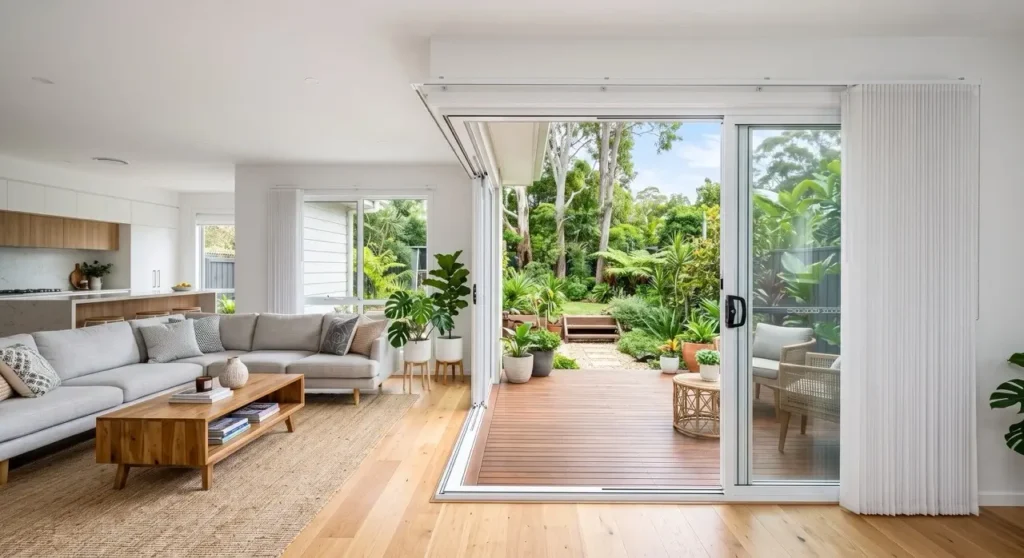
Vertical Blinds are commonly used for wide windows or sliding doors for a structural reason: their vertical design allows them to stack neatly to the side, making them perfect for frequent use and easy door access.
Roller blinds, by contrast, have to be raised entirely out of the way to access the door – and on a very wide sliding door, that can mean a serious amount of fabric bunched up at the top, or multiple panels may be required for wide doors, which can create gaps, and they often need to be fully raised or lowered for door access.
If your sliding door gets used multiple times a day – taking the dog out, kids running to the backyard, hosting people on the deck – vertical blinds are simply the more practical fit. You don’t have to choose between privacy and access; you get both, simultaneously, every time.
For a wide window that you rarely if ever walk through, that calculus changes – which brings us to the next point.
Where Roller Blinds Genuinely Win
It would be a pretty one-sided comparison if we didn’t give roller blinds their due, because there are real situations where they’re the better call.
Smaller and standard windows. Roller blinds are usually the more cost-efficient option for small to medium-sized windows. If you’re outfitting a bedroom, study, or kitchen window that doesn’t need to double as a doorway, roller blinds are often simpler, cheaper, and just as effective.
Bold pattern and colour. Vertical blinds come in a variety of materials and tend to be more muted colours, working beautifully for interiors that seek a sleek, minimalist vibe. If you’re following the maximalist trend and want bold colour and high-impact pattern, a roller blind is your best bet – we’re seeing more and more roller blinds with gloriously bold patterns and images.
Cleaning simplicity. This one’s pretty universally agreed upon. In terms of material, both types just need to be wiped over with a damp cloth, but wiping over every individual slat on a vertical blind takes a lot more time – rollers come out on top for being quick to clean. (Though as we covered in our vertical blinds cleaning guide, the process really isn’t as time-consuming as people expect once you’ve got a system down.)
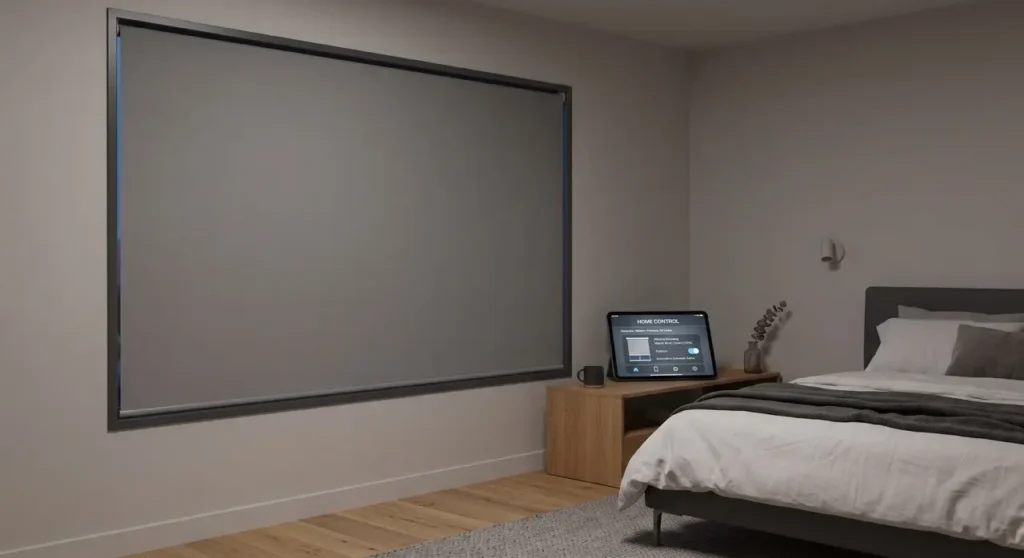
Motorisation and automation. In the automation conversation, roller blinds tend to have a slight edge – motorised systems allow you to adjust blinds remotely via smartphone or voice command, improving convenience. That said, IMEKO Blinds offers motorised options across both vertical and roller ranges, so this gap has narrowed significantly with quality suppliers.
Side-by-Side Comparison
Here’s the full picture in one place:
| Feature | Vertical Blinds | Roller Blinds |
|---|---|---|
| Best for | Sliding doors, large windows, wide openings | Standard windows, bedrooms, smaller spaces |
| Light control precision | High – tilt slats throughout the day | Moderate – generally up/down or fully closed |
| Privacy with gaps | Minimal side gaps when closed | Possible side gaps, especially on wide windows |
| Door/frequent access | Excellent – slats stack to the side | Limited – must raise fully for clear access |
| Cleaning effort | Slightly more (individual slats) | Quicker (single fabric sheet) |
| Pattern & colour range | More muted, classic tones | Bold colours, patterns, and prints available |
| Cost (small-medium windows) | Generally higher due to track and slat materials | More budget-friendly |
| Cost (large windows/doors) | Often better value for oversized openings | Can require multiple panels, adding cost |
| Insulation | Good, helps control sunlight direction | Slightly better with blockout fabrics |
| Visual style | Sleek, structured, contemporary or classic | Minimalist, modern, customisable |
What About Melbourne’s Climate Specifically?
Both products can perform well here, but it’s worth thinking about how Melbourne’s particular conditions interact with each one.
Our summers bring intense, direct sun – often from the west in the late afternoon, which is brutal on living areas with large glass doors. Blockout roller blinds insulate rooms effectively by creating a thermal barrier, while vertical blinds help control sunlight direction, reducing glare without closing off a space completely.
What this means practically: if you’ve got a west-facing bedroom that needs to be genuinely dark and cool for sleeping, a quality blockout roller blind is hard to beat. But if you’ve got an open-plan living area with a sliding door where you want to manage harsh light throughout the day without sacrificing the connection to your outdoor space, vertical blinds give you that ongoing flexibility a roller blind simply can’t match.
Melbourne’s notorious four-seasons-in-a-day weather pattern is actually a solid argument for vertical blinds in living spaces – being able to make small adjustments as conditions change, rather than committing to fully open or fully closed, suits our unpredictable climate rather well.
A Simple Way to Decide
If you’re still on the fence, run through these questions:
Is this window also a door, or a wide opening you walk through regularly?
Vertical blinds, almost every time.
Do you want to fine-tune light levels throughout the day, or is “open” and “closed” good enough?
Fine-tuning points to vertical blinds. Simple on/off points to roller blinds.
Is this a smaller, standard-sized window in a bedroom or study?
Roller blinds will likely serve you well and cost less.
Do you want a bold colour or pattern as a design statement?
Roller blinds offer more range here.
Is total blackout your top priority for sleep?
A quality blockout roller blind is purpose-built for exactly this.
Are you working with a large, wide, or non-standard window?
Vertical blinds tend to offer better proportional value and coverage.
You Don’t Have to Choose Just One
Here’s something worth knowing: plenty of Melbourne homes use both. Vertical blinds on the living room sliding door, roller blinds in the bedrooms and study. There’s no rule saying your whole house needs matching window treatments – and honestly, choosing the right product for each space usually looks more considered than forcing one style to do every job in the house.
IMEKO Blinds carries both premium vertical blinds and a full roller blinds range, so you’re never stuck compromising one room to make another work. Our consultants can walk through your whole home and recommend the right mix based on how each room actually gets used – not just a one-size-fits-all answer.
Still unsure which is right for your space? Book a free in-home consultation and we’ll bring samples of both so you can see and feel the difference before deciding.
FAQs: Vertical Blinds vs Roller Blinds
Which is cheaper, vertical blinds or roller blinds? For smaller to medium windows, roller blinds are typically more budget-friendly due to simpler materials and construction. For large windows or sliding doors, vertical blinds can actually offer better value, since roller blinds may require multiple panels to cover the same width.
Which is easier to clean? Roller blinds have the edge here – a single flat sheet of fabric is quicker to wipe down than dozens of individual slats. That said, vertical blind cleaning is very manageable with the right routine (we cover this in detail in our vertical blinds cleaning guide).
Can I use vertical blinds on a normal window, not just a sliding door? Absolutely. Vertical blinds work well on any wide window, especially in living rooms, home offices, and dining areas where you want flexible light control throughout the day.
Are roller blinds safer for kids and pets? Modern roller blinds with chainless or motorised operation are very safe. Vertical blinds with wand control or chainless louvre design are equally safe – the key factor is choosing a cordless or tensioned system rather than the operating type itself.
Do vertical blinds work in small rooms? They can, but the stack width (the space slats take up when fully open) needs to be factored into the room’s layout. In tighter spaces, roller blinds’ compact rolled-up profile can be more space-efficient.
Wrapping Up
There’s no universal winner here – and that’s actually the whole point. Vertical blinds shine on sliding doors, large openings, and anywhere you want ongoing light control throughout the day. Roller blinds shine on standard windows, bedrooms needing full blackout, and spaces where you want bold colour or pattern.
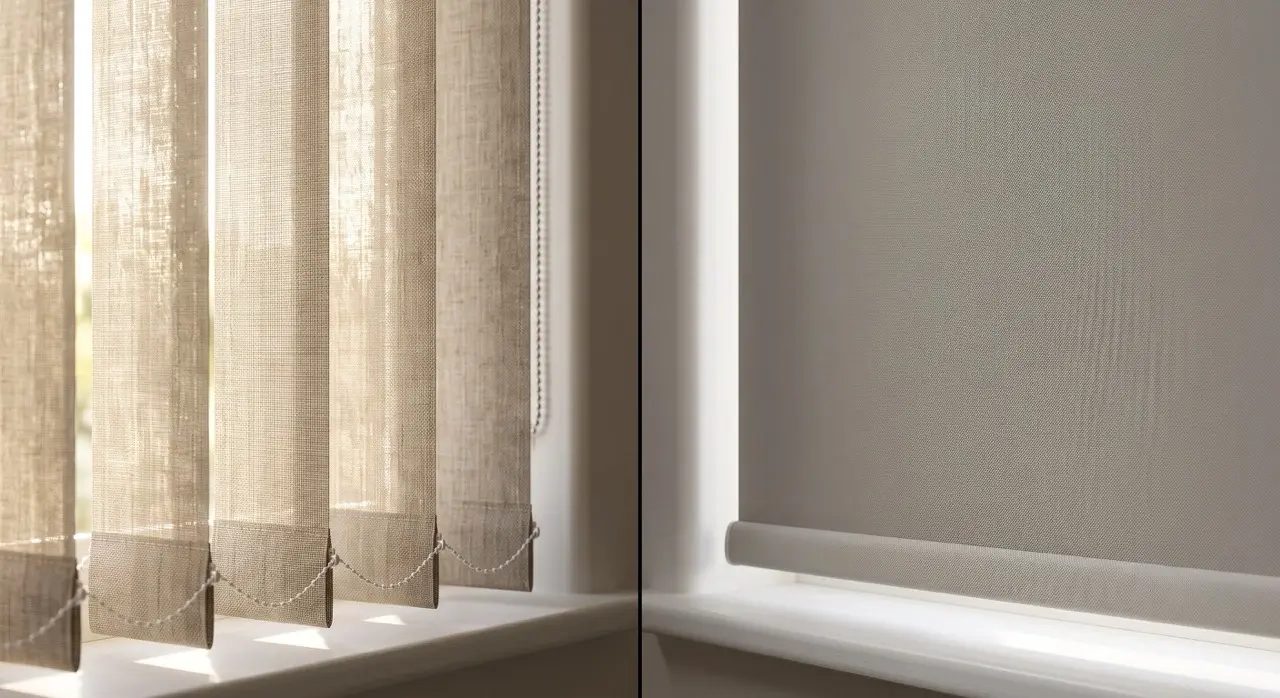
The smartest approach is usually matching the product to the room, not the room to the product. And if you’re still genuinely torn, that’s exactly what a proper in-home consultation is for – seeing both options in your actual space, in your actual light, before committing to anything.
Next up in this series, we’re tackling an even bigger comparison: how vertical and roller blinds stack up against plantation shutters – a popular upgrade for Melbourne homeowners looking for a more premium, long-term window solution.
References & Further Reading
- The Blind Crew – Vertical Blinds vs Roller Blinds – Australian comparison covering insulation, automation, and coastal conditions
- Elain Blinds – Roller Blinds vs Vertical Blinds: Which Should You Choose? – Detailed Australian breakdown of cost, durability, and maintenance
- Into Blinds – Are Roller Blinds Less Expensive Than Vertical Blinds? – Pricing comparison for Australian homeowners
- Into Blinds – Are Vertical or Roller Blinds Better for Sliding Glass Doors? – Sliding door-specific comparison
- Deluxe Blinds – Vertical Blinds vs Roller Blinds: Which Option Is Best? – Australian retailer comparison on light control and durability